Is microdosing legal in Canada? For most people, the short answer is no. Psilocybin and psilocin, the compounds in magic mushrooms, are Schedule III substances under the federal Controlled Drugs and Substances Act, and the law makes no exception for small doses (Controlled Drugs and Substances Act). A handful of narrow legal routes do exist, and the rules shifted again in 2026.
At STEM, we make measured psilocybin chocolate in small batches in BC, and we get asked about the law more than almost anything else. We think you deserve a straight answer. This guide covers what federal law says, the penalties, the legal access routes, what changed in 2026 and what it all means if you are thinking about microdosing in Canada.
Disclaimer: This article is general information, not legal advice. If you have a specific legal question, talk to a Canadian lawyer.

Is Microdosing Legal in Canada? The Short Answer
Let’s break it down. Microdosing usually means taking a small amount of a psychedelic, often 0.1 to 0.3 grams of dried mushroom, on a schedule. Federal law does not treat that amount any differently from a larger dose. Health Canada states that the production, sale and possession of magic mushrooms are illegal in Canada unless Health Canada authorizes them (Health Canada).
So, is microdosing legal in Canada for personal use? Not without authorization. The legal routes that exist run through Health Canada: approved clinical trials, the Special Access Program and personal exemptions under section 56 of the Act. We cover each one below.
What Federal Law Says About Psilocybin in Canada
The Controlled Drugs and Substances Act (CDSA) is the federal law that controls psilocybin. Because it is federal, it applies the same way in every province and territory. A city or a province cannot make psilocybin legal on its own.
Health Canada also notes that “there are no approved therapeutic products containing psilocybin in Canada or elsewhere.” That means no pharmacy can fill a regular prescription for psilocybin, and no store is licensed to sell it to the public.
Psilocybin Penalties Under the CDSA
The CDSA sets maximum penalties for Schedule III substances. Here are the ones that matter most, taken from the text of the Act:
| Offence (Schedule III) | Indictable maximum | Summary conviction maximum |
|---|---|---|
| Possession (s. 4(6)) | 3 years | First offence: $1,000 fine and/or 6 months. Later offences: $2,000 fine and/or 1 year |
| Trafficking or possession for trafficking (s. 5(3)(b)) | 10 years | 18 months |
| Production (s. 7(2)(c)) | 10 years | 18 months |
These are maximums, not typical sentences. They still show that possession of a microdose is a criminal offence under federal law.
Decriminalized vs Legal: What the Words Mean for Microdosing
These two words get mixed up a lot, and the difference matters.
- Illegal means the law prohibits the activity and sets criminal penalties. This is where psilocybin sits in Canada today.
- Decriminalized means possession of small amounts is no longer treated as a crime, often with other rules attached. Selling or producing the drug usually stays illegal. BC’s pilot worked this way for some drugs, but never for psilocybin.
- Legal and regulated means the government licenses who can make and sell the product and sets rules for quality and labels. Cannabis became legal and regulated in Canada through the Cannabis Act. Psilocybin has not.
When someone tells you microdosing in Canada is “basically legal,” ask which of these they mean. Under federal law, the honest answer is still “illegal unless authorized.”
Magic Mushroom Stores and Online Shops: Why They Are Not Legal
You may have seen magic mushroom storefronts in some Canadian cities, or online shops that ship across the country. That visibility makes many people assume microdosing in Canada is legal, or at least decriminalized. It is neither. A business being open does not change the federal law, and Health Canada notes that products from unregulated sources are not tested and that the strength of magic mushrooms “can vary greatly.”
Here is why that matters for safety too. Researchers at Oregon State University bought 12 “magic mushroom” edibles in Portland, Oregon and found that none of them contained psilocybin, and seven held ingredients that were not on the label (Oregon State University). Legal risk and product risk often go together.
BC’s Decriminalization Pilot and Psilocybin
British Columbia ran a three-year pilot that decriminalized possession of small amounts of some illicit drugs for adults. Psilocybin was not part of it. According to the BC Centre for Disease Control, “Decriminalization ended on January 31, 2026,” and the exemption “will not be renewed” (BCCDC). As of 2026, no part of Canada has decriminalized psilocybin.
Legal Ways to Access Psilocybin in Canada in 2026
While general possession is illegal, Health Canada does allow a few narrow, supervised routes. None of them is a quick path to microdosing at home, but they are real.
1. Psilocybin Clinical Trials Authorized by Health Canada
Researchers can run psilocybin clinical trials with Health Canada authorization. A newer class exemption, effective September 20, 2025, lets participants in an authorized trial that involves at-home use possess “the quantity and form of MDMA or psilocybin obtained from the qualified investigator,” and return any unused product (Health Canada). This is the closest thing to legal microdosing in Canada right now, and it only applies inside an approved study.
2. The Special Access Program for Psilocybin
The Special Access Program (SAP) lets a practitioner ask Health Canada for a drug that is not approved for sale, for a patient with a serious or life-threatening condition. Health Canada has published guidance for practitioners on SAP requests involving psychedelic-assisted psychotherapy (Health Canada). You cannot apply yourself. Your practitioner applies for you, and Health Canada decides each request on its own.
3. Section 56 Psilocybin Exemptions
Section 56(1) of the CDSA lets the Minister exempt a person from the Act for a medical or scientific purpose, or if it is in the public interest. Some patients and health care practitioners have used this route.
In 2025, the Federal Court of Appeal ruled in Toth v. Canada, 2025 FCA 119, a case brought by health care practitioners, patients and the patient advocacy group TheraPsil. The court sent the practitioners’ exemption requests back to the Minister to decide again, but it did not order the Minister to grant them (Federal Court of Appeal).
What Changed in 2026: New Controlled Substances Rules and Psilocybin
Health Canada published new Controlled Substances Regulations on December 17, 2025, and they replaced the previous regulations for controlled substances on October 1, 2026 (Health Canada). The change brings several older sets of rules into one framework.
What does that mean for psilocybin? Health Canada said the class exemption that let pharmacists, practitioners and hospitals handle psilocybin and MDMA authorized through the SAP “will be revoked when the new Controlled Substances Regulations take effect on October 1, 2026” (Health Canada). The new regulations govern how those professionals handle controlled substances from that date.
The big picture did not change. Psilocybin is still a controlled substance under the CDSA, and personal microdosing without authorization is still illegal.
Alberta’s Psychedelic Therapy Rules
Alberta was the first province to set rules for psychedelic-assisted therapy. The College of Physicians & Surgeons of Alberta says the requirements were introduced in October 2022 and took effect on January 16, 2023 (CPSA). The Alberta government says providers of psychedelic drug treatment services must be licensed under the Mental Health Services Protection Act, unless exempted, and that a psychiatrist provides clinical oversight of licensed services (Government of Alberta). Approved clinical research trials are one of the exemptions.
Alberta’s rules cover how clinics operate. They do not make psilocybin legal, and they do not replace the federal authorization a clinic would still need to use it.
Psilocybin Chocolate and Microdose Products
Psilocybin chocolate, capsules and teas fall under the same federal law as dried mushrooms, because the CDSA controls the substance itself, not the form it comes in. We cover chocolate on its own in our guide to whether psilocybin chocolate is legal in Canada.
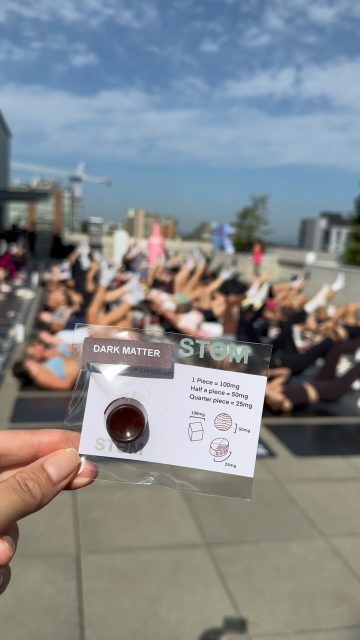
We will be honest about why people choose chocolate for microdosing: a measured piece is easier to dose than a dried mushroom. Our 1.5 g microdose bars split into 15 pieces of 100 mg, and our 3 g bars split into 15 pieces of 200 mg. Our mushroom chocolate dosage chart shows how to cut each bar, and our microdose collection lists our small-dose products. Buying them does not change what the law says.
Microdosing in Canada: What the Science Says
If you are weighing the legal risk, it helps to know what the evidence shows. The largest placebo-controlled microdosing study, run by Imperial College London with 191 people, found that both the microdose group and the placebo group felt better, with no clear difference between them (Szigeti et al., eLife, 2021).
In our view, that makes careful tracking even more useful for anyone who decides to microdose. It also means nobody should treat microdosing as a proven medical treatment. Health Canada is clear that no psilocybin therapeutic product is approved.
Microdosing Health and Safety Notes
Health Canada warns that using magic mushrooms with cannabis, amphetamines or alcohol raises the risk of serious side effects. It says magic mushrooms can raise heart rate and blood pressure, which could be harmful for people with heart disease, and that people with existing psychiatric conditions, or a predisposition to them, may face a higher risk of side effects. If you take medication or have a health condition, talk to a health care professional first.
Effects usually begin within 15 to 45 minutes and last four to six hours, according to Health Canada. Our guide on how long mushroom chocolate takes to kick in explains the timeline. STEM chocolates are not intended to diagnose, treat or cure any condition.
Questions to Ask Yourself Before Microdosing
If you are thinking about microdosing, here is the checklist we would want a friend to run through first:
- Is there a legal route for me? A clinical trial, a Special Access Program request or a section 56 exemption are the authorized options.
- Do I have a heart condition, a psychiatric history or take medication? Health Canada flags these as higher-risk situations, so talk to a health care professional first.
- Do I know the dose? A strain name or a label without an amount per piece does not tell you how much psilocybin you are taking.
- Can I track it? Write down the dose, the date and how you felt, so you judge the result on real notes.
FAQs: Is Microdosing Legal in Canada?
Is microdosing mushrooms legal anywhere in Canada?
No. The CDSA is federal law and applies in every province and territory. BC’s decriminalization pilot ended on January 31, 2026, and it never covered psilocybin.
Can my doctor prescribe psilocybin for microdosing?
Not through a regular prescription, because no psilocybin product is approved for sale. A practitioner can apply to Health Canada’s Special Access Program for a patient with a serious or life-threatening condition, and Health Canada decides each request.
Can I join a psilocybin microdosing clinical trial?
Possibly. Health Canada authorizes clinical trials, and since September 20, 2025, participants in an authorized trial with at-home use can possess the psilocybin the trial provides. Ask your health care provider about trials that may suit you.
Is buying psilocybin chocolate online legal in Canada?
No. Buying psilocybin products without Health Canada authorization is illegal under federal law, whatever form the product takes.
What are the penalties for psilocybin possession in Canada?
Under section 4(6) of the CDSA, the maximum on indictment is three years. On summary conviction, a first offence carries up to a $1,000 fine, six months in prison or both.
Did the 2026 regulations legalize psilocybin?
No. The new Controlled Substances Regulations that took effect on October 1, 2026 changed how professionals handle controlled substances. Psilocybin is still controlled under the CDSA.
The Bottom Line on Microdosing in Canada
So, is microdosing legal in Canada in 2026? Not for general personal use. The legal routes are real but narrow: an authorized clinical trial, a Special Access Program request from your practitioner or a section 56 exemption.
If you want to keep learning, read our guide to whether psilocybin chocolate is legal in Canada, check the dosage chart to see how a measured piece works, or visit the STEM homepage to learn how we make our chocolate. We believe that by changing our minds, we can change our lives, and that starts with honest information.